01
Different products, different risks
Combustible tobacco and smoke-free nicotine products should not automatically be regulated as though they pose the same level of harm.
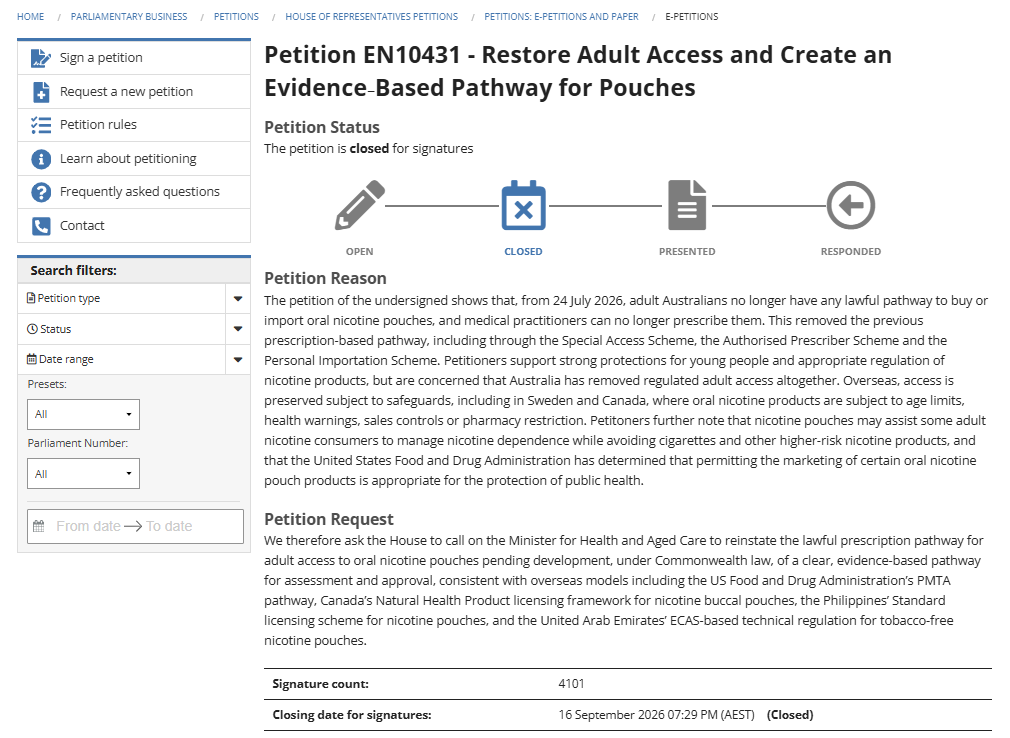
A consumer-led movement calling for the return of the GP-supported prescription pathway for regulated nicotine pouches.
Lawful access to nicotine pouches was prohibited and the previous Schedule 4 GP-supported pathway was removed. Adults who had used regulated pouches as an alternative to smoking or vaping were left without a clear legal pathway.
Why This Matters
Our rebuttal addressing factual gaps and unintended consequences in the Minister’s 24 July announcement, with a focus on adults who rely on safer nicotine alternatives, and correcting key misconceptions about nicotine pouches.
Min of Health RebuttalAMA RebuttalProtecting young people is essential. But youth protection and adult access are not mutually exclusive. A proportionate framework can do both.
Combustible tobacco and smoke-free nicotine products should not automatically be regulated as though they pose the same level of harm.
Adults previously accessed regulated products through a GP-supported prescription pathway rather than an unrestricted consumer market.
Removing lawful alternatives may redirect some adults toward cigarettes, vaping, or informal supply.
Certain nicotine pouch products have been authorised by the FDA following regulatory review.
Risk-proportionate approaches to non-combustible nicotine sit alongside comparatively low smoking prevalence.
Non-combustible nicotine products form part of a wider harm-reduction environment for adults who smoke.
The arguments for and against prohibition, addressed directly. Review the key questions and the evidence behind them before adding your name to the petition.
Their stated concerns are that nicotine pouches are not approved under Australia’s current regulatory framework, could increase nicotine dependence, and may appeal to young people through marketing and product design. They have also argued that stronger controls are needed to reduce illicit trade and protect public health.
Protecting young people and reducing nicotine addiction are legitimate public health goals. The question is whether prohibition is the most effective way to achieve them. An alternative approach is to regulate product standards, age verification, marketing, and retail compliance while maintaining appropriate access for adults.
Prohibition does not necessarily eliminate demand. Experience with other nicotine products suggests that when legal access is removed, consumers may turn to illicit or unregulated markets, making enforcement and product oversight more difficult.
Youth uptake is a genuine concern and should be addressed through strict age restrictions, responsible marketing, packaging requirements, and retailer enforcement. International experience suggests these measures can form part of a comprehensive regulatory framework.
Any nicotine product requires careful regulation. The challenge is designing safeguards that minimise youth uptake while recognising that some adult smokers may use lower-risk alternatives as part of their transition away from combustible cigarettes.
Many countries regulate nicotine pouches rather than prohibit them outright. A review covering 67 countries found that regulatory approaches commonly include age restrictions, warning labels, marketing controls, product standards, and sales requirements.
No. Although nicotine is addictive, cigarettes cause most tobacco-related disease because they involve combustion. Nicotine pouches are non-combustible products, and published scientific literature generally places them substantially lower on the risk continuum than smoking.
ACA supports regulating products according to their level of risk. Where concerns relate to youth access, marketing, or product safety, regulation should directly address those issues through standards, enforcement, and oversight rather than relying solely on prohibition.
“Protect young people through strong regulation. Preserve appropriate access for adults. Build policy on evidence rather than prohibition.”
The petition calls for a regulated, evidence-based approach that protects young people without denying adults access to appropriately controlled alternatives.
Policy decisions affect real people. This section will feature verified stories from adults who used nicotine pouches to move away from smoking or vaping.
“I smoked cigarettes for 30 years and tried many times to quit, including using Champix, without success. After switching to vaping for 10 years, I finally stopped completely in February this year by using nicotine pouches and have not had a single cigarette or vape since. I am deeply disappointed that a product available only with a doctor’s prescription is now being banned, while cigarettes and vapes remain legal. I urge the Government to reconsider this decision and continue allowing personal importation of nicotine pouches for adults with a valid prescription.”
“The only thing that helped me stay off cigarettes was switching to nicotine pouches, a safer, smoke-free alternative that fits quietly into my life.”
“Unlike vaping, nicotine pouches are the only nicotine product I have used where I experienced no adverse health effects.”
“My name is Thomas Gregory, I have been a smoker of cigarettes since 16, vapes since they came through and became easily accessible and now being 31 and in a public position of work, I started ZYNS. I did this not just for myself and stress. I did this because I felt that after years of these other options I had troubles breathing and sleeping.
Now after the change to ZYNS and the child, I have had more energy, I’m more active getting involved with my kids, my kids have enjoyed the change, even at work it’s noticeable and people enjoy being around me there as well.”
“My journey with nicotine has been a long one, and it started when I was only 13 years old.
For the first time in decades, I felt like I was actually in control of nicotine instead of nicotine controlling me.
After everything I have done to get here, it is incredibly disappointing to feel like government decisions could push people backwards instead of helping them move forwards.”
“I smoked cigarettes for years and always knew I needed to quit, but breaking the habit wasn’t easy. Switching to nicotine pouches has been one of the best decisions I’ve made. I no longer have the smell of cigarette smoke on my clothes or in my car, and I don’t have to step outside for a smoke break.
While nicotine pouches aren’t risk-free and still contain nicotine, they’ve been a much better alternative for me than continuing to smoke cigarettes or vaping. They’ve helped me move away from smoking and vaping and I feel like I’ve taken a positive step toward improving my health and everyday life. With ban coming into effect, I’m back to square one with finding another alternative.”
How pouches affected smoking/vaping
I was in hospital for two months from a non-smoking-related illness, and the only thing I had with me was a vape. I found myself waking up every two hours just to inhale on it. After I was discharged, I realised how badly my respiratory system had been affected. Switching to nicotine pouches was the only thing that helped me finally kick the vape — something patches or gum never managed to do.
How the ban affects me
I was buying pouches legally. Now, because of the ban, I’m forced to get them from dodgy tobacconists that have popped up everywhere over the last five years. It’s still better than going back to vaping, but it shouldn’t be like this.
How pouches affected smoking/vaping
I’ve used nicotine pouches to stop both smoking and vaping, and they’ve noticeably improved my health. After years of trying everything — Champix, over-the-counter quit products, lozenges — pouches were the only thing that actually worked long-term.
How the ban affects me
I’ve been a heavy smoker since the age of nine. Champix nearly cost me my life due to the mental side effects. Every quit product I tried only kept me off cigarettes for a few months before I relapsed. I moved to vaping, but that damaged my health just as much, if not more.
For the last two years, nicotine pouches have been the only safe, effective option that kept me away from smoking. Since the ban, I’ve already gone back to cigarettes. I tried to hold out with lozenges, but they only work when life is smooth — and life hasn’t been smooth for me, especially with my mother dying of cancer.
I hate smoking and regret ever starting. It’s not ideal to use any nicotine product long-term, but pouches were the safest non-smoking, non-vaping alternative available. Just because our government refuses to do the research doesn’t mean others haven’t. Swedish and Norwegian research is extensive. Maybe our government should look at it too.
How pouches affected smoking/vaping
I have smoked on and off for nearly 15 years, the only thing that worked to stop smoking cigarettes was vaping. However I still noticed that vaping wasn’t great for my cardiovascular health. On a trip to the Europe I discovered nicotine pouches, since then I was using the TGA prescription system to import good quality nicotine pouches from Sweden that I knew weren’t contaminated and contained correctly labelled dosages. Using pouches stopped all vaping and smoking desires and have found a huge improvement in my health since starting pouches.
How pouches affected smoking/vaping
They were the only thing that got me off smoking and vaping. Current products like the disgusting gum from the pharmacy is a joke.
The government wants people to stay on the durries they are the most disgraceful f...heads in the world
How pouches affected smoking/vaping
I’m from Sweden, a country that genuinely care about its citizens and health is a serious topic and properly research given that health care is completely financed by government. Nicotine pouches reduce smoking dramatically and the health statistics clearly drove decisions on why nicotine pouches is an important alternative (a much healthier that smoking).
How pouches affected smoking/vaping
As a younger kid, i unfortunately became hooked on nicotine through vapes. I vaped continuously for 4 years, and every quitting method seemed unsuccessful. I had many adverse health effects from vaping, until i came across nicotine pouches. Within two weeks, i was able to stop vaping completely, and have been lowering my intake progressively in an effort to eventually quit.
How pouches affected smoking/vaping
I was a smoker for 15 years. On at least 4 occasions, I attempted quitting through the existing smoking cessation products including patches and gum, although on all occasions relapsed back to cigarettes. I started using pouches 2 years ago and have not had a cigarette since. The reduction in population smoking rates should be celebrated but not correlated with prohibiting all access to nicotine products and goes against validated and evidenced based treatment of addiction that recognises the importance of harm minimisation.
How pouches affected smoking/vaping
Nicotine pouches helped me quit vaping. I was vaping so often that it was starting to affect me physically, my lungs and body felt irritated and I ended up getting sick often.
How pouches affected smoking/vaping
Pouches stopped me from both vaping and smoking almost immediately. I have never felt healthier and have never been tempted to pick up a cigarette again. How the ban affects them This ban has taken away my only legal means of purchasing these pouches that have helped me so much. It has immediately forced me to buy them from smoke shops where the legitimacy and safety of the product is questionable.
How pouches affected smoking/vaping
I used to smoke 2 packs a day previously. I tried other quitting approaches, including vapes and nicotine gums. None of them worked. I have stopped smoking now for 4 years and have been using nicotine pouches. I feel the change in my body after quitting smoking.
How the ban affects them
With the ban on nicotine pouches, there are no realistic alternatives available to me to access nicotine products legally, except to move to smoking – which I don’t want to do.
How pouches affected smoking/vaping
Nicotine pouches were the only thing that got me to quite a 30 a day cigarette addiction for 20 years.
Pouches saved my life.
How the ban affects them
Have to go back to smoking or start vaping.
I used to vape all day every day. When I first started using nicotine pouches, they immediately became a better alternative. Instead of feeling drained and my chest hurting from vapes, I was able to switch to a new nicotine intake that did not affect my lungs and can be scaled down to a cessation of nicotine usage.
Have nicotine pouches helped you move away from smoking or vaping? Your experience can help policymakers understand how the current approach affects adult Australians.
Receive petition updates, evidence summaries, campaign news, and opportunities to participate.
A consumer-led, non-commercial initiative supporting evidence-based nicotine policy, strong youth safeguards, and proportionate adult access.
Adult lived experience sits at the centre.
Claims should be supported by transparent sources.
Strong age controls remain essential.
No product promotion or retail sales.